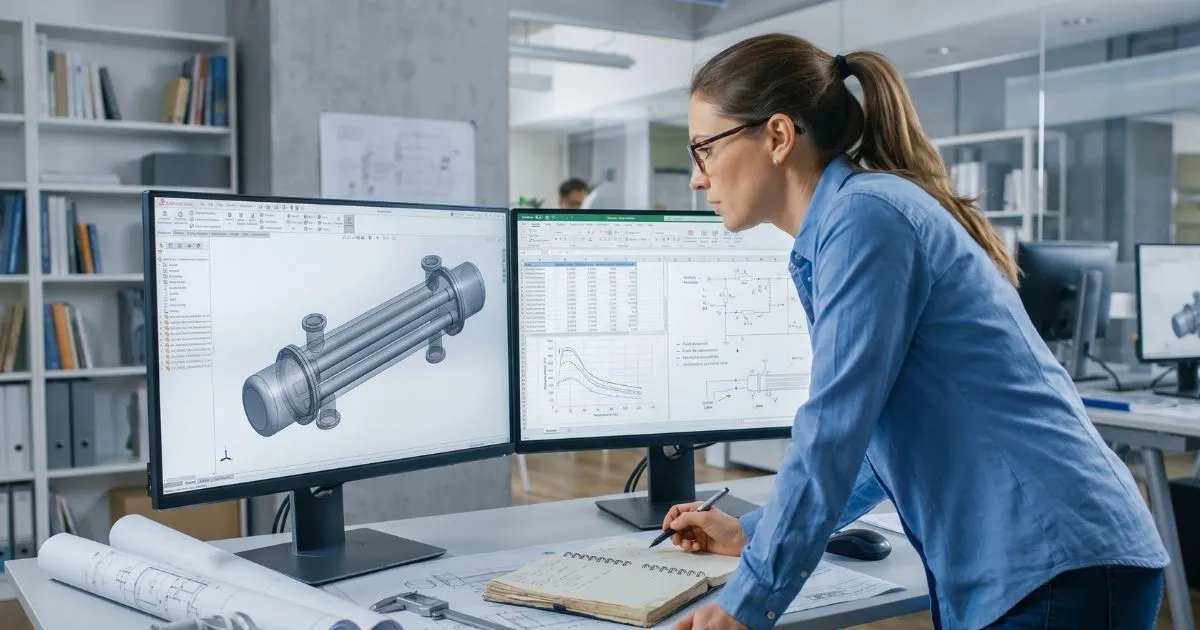
Choosing the right heat exchanger calculation software is not only about finding a tool that produces a thermal result. For engineering teams and heat exchanger manufacturers, the calculation is usually one part of a wider process that includes product selection, configuration, technical documentation, pricing, and quotation.
A platform may calculate accurately but still create extra work if engineers need spreadsheets, separate applications, or repeated data entry to complete the rest of the job. The better approach is to evaluate how well the software supports the complete engineering workflow and how easily it can adapt to the products your company actually designs and sells.
That makes the selection process more practical. Instead of comparing long feature lists, teams can focus on the capabilities that affect daily engineering work, collaboration, and the path from customer requirements to a technically valid and commercially usable solution.
Start With the Calculations Your Team Actually Performs
The first step is to map the calculations your engineers perform today. Look at the operating conditions they receive, the fluids and materials they work with, the geometries they need to evaluate, and the outputs they prepare for the next stage of the process.
This helps separate essential requirements from features that may look impressive but have little value in daily use. If the software cannot support the conditions and product logic your team depends on, engineers will continue using external tools and manual checks.
Reliable thermal calculations remain the foundation. But the software should also provide enough technical detail for engineers to understand the result, compare alternatives, and make confident design decisions rather than treating the calculation as a black box.
Make Sure It Supports the Heat Exchanger Types You Build
Heat exchanger requirements vary by product family. Plate heat exchangers, shell and tube units, and finned packs or coils do not follow exactly the same geometry, configuration, or selection logic. A manufacturer working across several types therefore needs more than a generic calculation interface.
When comparing platforms, check whether the software can represent the exchanger types you manufacture today and whether it can accommodate additional product families later. The important question is not simply whether a product type appears in a menu, but whether the system can support the technical parameters, materials, geometries, operating limits, and selection rules behind it.
For example, Alfa Laval’s plate heat exchanger calculation guidance highlights inputs such as heat load, inlet and outlet temperatures, allowable pressure drop, operating temperature and pressure, and flow rate. Your own requirements may differ, but the principle is the same: the software needs to reflect the variables that genuinely drive your engineering decisions.
Look for Technical Depth, Not Just a Fast Result
A calculation result is useful only when engineers can evaluate whether the proposed solution is technically appropriate. Depending on the application, teams may need to review pressure drop, thermal margins, physical properties, operating limits, alternative configurations, and other performance data.
This is why professional engineering tools are often evaluated on the depth of their analysis as well as their speed. The goal is not to add unnecessary complexity, but to give engineers enough information to understand why a configuration works and how it compares with other options.
HTRI’s Xchanger Suite is one example of an established engineering environment that supports rating, simulation, and design across different heat-transfer equipment. It provides a useful external reference for the level of technical detail engineering users may expect when evaluating specialized calculation tools.
Configurability Is Important for Manufacturer-Specific Rules
Two heat exchanger manufacturers can sell similar products while using different geometries, materials, model ranges, calculation logic, selection criteria, accessories, price structures, and documentation. This makes configurability one of the most important areas to evaluate.
Engineering calculation software should be able to reflect the way your company works instead of forcing your products into a fixed structure. Depending on the business, this may include calculation parameters, geometries, materials, available models, technical data, drawings, images, accessories, price lists, and quotation templates.
This flexibility also matters over time. Product ranges change, engineering rules are updated, new materials are introduced, and commercial requirements evolve. A system that is difficult to adapt may eventually create the same limitations as the legacy tools it was intended to replace.
Companies with highly specific engineering or operational requirements can also explore Custom Software Solutions for systems designed around their own workflows, data structures, and business logic.
Calculation and Product Selection Should Work Together
Once the required thermal performance has been determined, engineers still need to identify a suitable product or configuration. If the selection stage happens in another spreadsheet or application, the workflow remains fragmented.
A stronger process connects calculation and selection so that technically suitable options can be evaluated without recreating the same data. Engineers should be able to compare alternatives according to the company’s own technical rules and choose the configuration that best fits the application.
Dedicated tools such as Alfa Laval PHE Select show the value of connecting operating conditions with product selection. For manufacturers evaluating a broader platform, the same principle applies: calculation should lead naturally into a structured selection process rather than becoming an isolated technical step.
Think About What Happens After the Engineer Selects a Product
One of the most useful questions to ask during software evaluation is what happens after a technically valid configuration has been selected. In many businesses, this is where manual work begins.
Product information may be copied into spreadsheets, prices checked in another file, accessories added manually, and quotations prepared in separate templates. Each handoff adds time and creates another opportunity for inconsistent data.
When calculation, configuration, and commercial preparation are connected, the selected product can remain consistent throughout the process. This can make it easier for engineering and sales teams to work from the same information instead of maintaining different versions of the same configuration.
Where repetitive handoffs or manual steps remain around these processes, Accleverate Flow AI can help identify workflow bottlenecks and automate suitable business tasks.
Pricing and Quotation Capabilities Can Reduce Repeated Work
Heat exchanger pricing can depend on more than a standard product code. Materials, dimensions, components, accessories, customer requirements, and configuration choices may all affect the final price.
For manufacturers with complex products, connecting engineering data with pricing or CPQ logic can reduce the need to rebuild the selected configuration in another tool. The technical solution becomes the basis for the commercial offer, helping teams maintain consistency between what was calculated and what was quoted.
Quotation generation is also worth reviewing. A customer may need technical specifications, performance data, datasheets, drawings, product images, accessories, and commercial information. If the software can reuse data already produced during calculation and selection, teams can prepare professional documents with less manual formatting.
Check How Product Data Is Managed
Calculation software often depends on information stored across multiple locations. Technical parameters may be in one application, pricing in spreadsheets, drawings in folders, and customer or project data in CRM or ERP systems.
A new platform does not necessarily need to replace every system, but it should have a clear role in the data flow. Teams should understand which information is maintained in the calculation environment, which data comes from other systems, and where the final configuration needs to go.
Reducing duplicate data entry can improve consistency and make updates easier to control. It also helps prevent situations where different departments are working from different versions of product or pricing information.
Integration Matters When Engineering Is Part of a Larger Workflow
Heat exchanger calculation rarely exists completely on its own. Customer information may originate in a CRM, product and pricing data may connect with an ERP, and accepted quotations may eventually move into production or order management.
For that reason, integration capabilities should be part of the evaluation. APIs, structured data exchange, and connections with existing business systems can help information move through the organization without repeated manual entry.
The right level of integration depends on the company. A smaller engineering team may need only a few connections, while a manufacturer with complex sales and production processes may need calculation data to become part of a broader enterprise workflow.
For manufacturers that need calculation data to connect with wider business operations, Accleverate Pulse can support connected workflows across sales, production, warehouse, logistics, and operations.
Usability Should Support Engineers Without Oversimplifying the Work
Technical depth is important, but software can still become difficult to use if routine actions require too many steps. A clear interface should help users move through calculation, comparison, selection, and documentation without hiding the engineering information they need.
It is also useful to consider the different people who may use the platform. Experienced engineers may need detailed controls and transparent technical outputs, while sales engineers may need a more guided path from customer requirements to a valid configuration and quotation.
Good usability does not mean removing complexity from engineering. It means presenting that complexity in a structured way so that users can work efficiently and consistently.
Consider Accessibility and Collaboration
Traditional engineering applications are often installed on individual desktop computers. That approach may still be appropriate for some workloads, but it can create limitations when teams work across locations or when engineering and sales need to collaborate more closely.
Web-based access can make a platform easier to use across devices and locations, provided that technical functionality, performance, security, and user permissions are handled properly. For manufacturers with distributed teams or international sales operations, this can make engineering information easier to access without relying on a specific workstation.
The delivery model should therefore be evaluated as part of the workflow rather than as a technology preference. The question is whether it makes the work easier for the people who need to use the system.
Evaluate the Software Against Real Engineering Scenarios
A practical way to compare systems is to test them against real cases from your business. Use a typical customer request, a technically difficult calculation, a configuration with several alternatives, and a quotation that requires detailed documentation.
Then look at the full journey. How many times does the user need to re-enter information? Does the engineer need to leave the platform to complete important checks? Can the selected configuration continue into pricing and documentation? Are the outputs clear enough for both technical and commercial teams?
These real scenarios often reveal more than a generic feature checklist. They show whether the software fits the process when the work becomes complex, which is where engineering teams usually feel the limitations of their existing tools.
Plan for Future Products and Changing Requirements
Software that fits today’s product range may still become restrictive if it cannot evolve. Manufacturers may introduce new exchanger families, update geometries, change calculation rules, add price lists, expand into new markets, or connect engineering with additional business systems.
Before making a decision, ask how easily the platform can accommodate those changes. A configurable architecture can help preserve the value of the system as the business grows and reduce the risk of another disruptive replacement later.
This is particularly important when the company’s engineering knowledge is part of its competitive advantage. The software should support that knowledge and make it easier to apply consistently, not lock it into a structure that becomes difficult to maintain.
Heat Exchanger Software FAQ: Calculations, Selection, and Workflows
What should heat exchanger calculation software include?
It should support the thermal calculations, fluids, materials, geometries, and exchanger types relevant to your products. For many manufacturers, it should also help with product selection, configuration, technical documentation, and connections to pricing or quotation workflows.
Is heat exchanger calculation software only for engineers?
Not necessarily. Engineers are usually the primary technical users, but sales engineers, product teams, and commercial teams may also use information generated by the system for product selection, pricing, technical documents, and quotations.
Why is configurability important in engineering calculation software?
Manufacturers often use company-specific geometries, product rules, materials, selection logic, price structures, and documentation. Configurability allows the software to reflect those requirements instead of forcing the business into a generic workflow.
Should calculation software include product selection?
For manufacturers that calculate and sell configurable heat exchangers, connecting calculation with product selection can reduce manual steps and make it easier to compare technically suitable options using consistent engineering rules.
Can heat exchanger calculation software connect with ERP or CRM systems?
Yes, depending on the platform. Integration through APIs or structured data exchange can help customer, product, pricing, quotation, and order information move between engineering software and other business systems.
Choose Software That Supports the Complete Engineering Workflow
The best software for heat exchanger calculations is not necessarily the platform with the longest feature list. It is the one that supports the technical work your engineers perform, reflects your product rules, and fits the wider process around calculation, selection, pricing, documentation, and quotation.
For some manufacturers, the priority will be deeper calculation capabilities. For others, the biggest improvement will come from connecting engineering with commercial workflows or replacing spreadsheets and disconnected tools. Defining those priorities before comparing systems makes it easier to choose a platform that delivers value beyond the initial calculation.
Cleverativity has more than 25 years of experience developing software for HVAC and refrigeration applications. Accleverate HVAC+R is designed to support configurable heat exchanger calculation, selection, pricing, and quotation workflows for manufacturers. You can also explore the Cleverativity Academy for more articles on HVAC engineering software, enterprise systems, automation, and digital transformation.
Cleverativity has more than 25 years of experience developing software for HVAC and refrigeration applications. If your engineering team is looking to simplify heat exchanger calculation, selection, pricing, and quotation workflows, contact Cleverativity and discover how Accleverate HVAC+R can be configured around your products and engineering requirements.