
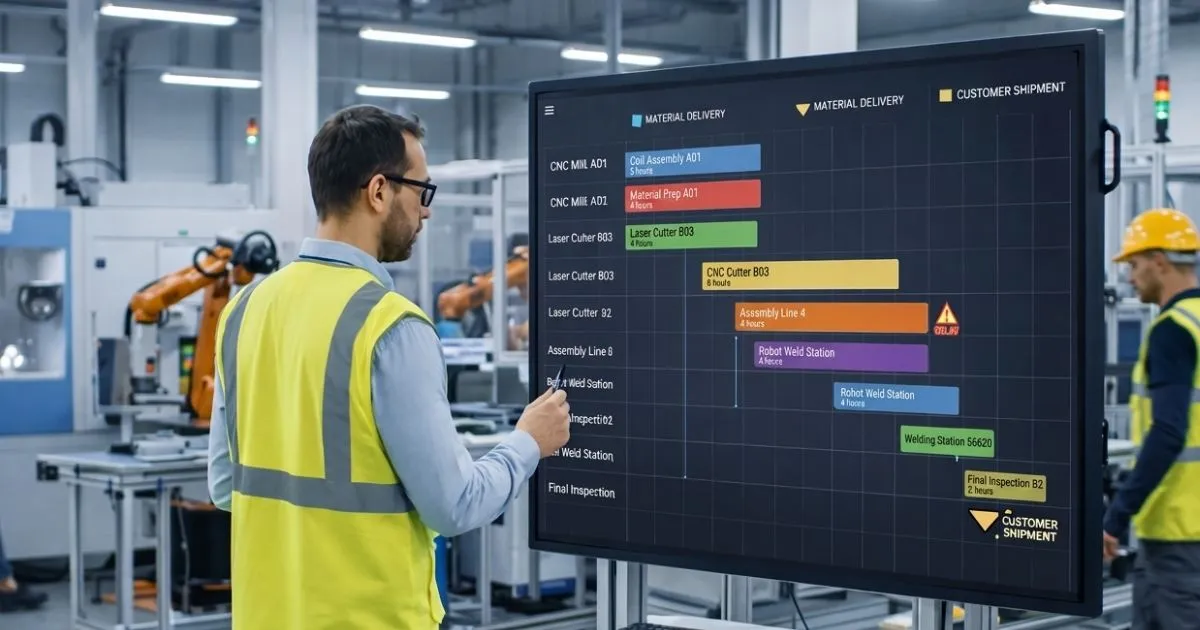
A customer delivery date may look like a simple promise, but meeting it depends on dozens of decisions inside the factory. Materials need to arrive at the right time, machines and people need to be available, operations must happen in the right sequence, and urgent orders cannot continually disrupt work that is already in progress.
This is where production scheduling becomes critical. A production plan can define what needs to be made, but the schedule turns that plan into an executable sequence of work. It connects customer demand with actual shop-floor capacity and helps teams understand what should happen, where it should happen, and when.
When scheduling is weak, manufacturers often compensate with spreadsheets, daily firefighting, overtime, expedited orders, and constant changes in priority. When scheduling is reliable and connected with real operational data, teams have a much better chance of protecting delivery dates without creating unnecessary pressure across production.
Production planning and production scheduling are closely related, but they solve different problems. Planning looks at what the business needs to produce over a broader period and whether demand can be supported by materials, labor, and equipment. Scheduling translates those requirements into specific timing, sequence, and resource assignments.
As IBM explains in its overview of supply chain planning, production planning determines when and where products will be made while coordinating raw materials, labor, and equipment. Scheduling takes that intent closer to execution by deciding how work should be arranged against real constraints.
The distinction matters because a feasible monthly plan can still fail on the shop floor. Two jobs may need the same machine at the same time. A critical component may not be available. A setup may take longer than expected. An urgent customer order may need to be inserted without pushing several other orders late. Production scheduling is where those conflicts become visible.
When orders begin to run late, the natural reaction is often to push production harder. Teams add overtime, expedite materials, move people between work centers, or ask machines to run longer. These actions can help temporarily, but they do not necessarily solve the reason the schedule became unreliable.
A factory can be busy and still deliver late. If work is released in the wrong sequence, bottlenecks become overloaded while other resources wait. If materials are missing, partially completed orders occupy space without moving. If priorities change constantly, teams spend time switching rather than completing work.
Better production scheduling focuses on flow rather than activity alone. It helps manufacturers decide which jobs should move first, which resources are constrained, and whether the promised completion date is realistic based on the work already in the system.
One of the biggest differences between a useful schedule and an optimistic one is how capacity is treated. A schedule that assumes unlimited machine time, labor, or work-center availability may look good on paper but become impossible as soon as production begins.
Realistic scheduling considers the capacity of critical resources. That can include machine availability, labor shifts, planned maintenance, setup time, tooling, subcontracted operations, and other constraints that determine how much work can actually be completed.
A recent NIST Manufacturing Extension Partnership case study illustrates the connection. After a manufacturer corrected routing information, configured work centers for scheduling, and addressed a welding bottleneck, it was able to provide more accurate lead-time estimates and reduce quoted lead times from 12-14 weeks to 5 weeks.
The lesson is not that every manufacturer needs the same scheduling method. It is that scheduling becomes more credible when the data behind capacity, routings, and constraints reflects what is actually happening in production.
Most production environments have resources that limit throughput at different times. A welding department may be overloaded this week, while a particular machine, inspection step, or external supplier becomes the constraint next week.
If every work center is treated as equally available, the schedule can release more work toward a bottleneck than it can process. Queues grow, lead times stretch, and downstream operations receive work inconsistently.
Scheduling should therefore make constraints visible and help planners protect the flow through critical resources. This does not mean every minute needs to be optimized mathematically. Even basic visibility into work-center load, queue length, and available capacity can improve decisions about sequence and promised dates.
NIST research on manufacturing investments has also identified bottleneck reduction and scheduling among high-return improvement areas, reinforcing how strongly these operational decisions can affect manufacturing performance.
A production schedule cannot be reliable if it assumes materials will be available when they are not. Releasing a job without the required components may make the schedule look active while creating work-in-progress that cannot be completed.
This is why manufacturing production scheduling needs to stay connected with material requirements and inventory information. Planners should be able to see whether the required components are available, expected, delayed, or already committed to another order.
The connection becomes especially important in make-to-order and configurable manufacturing, where different jobs may compete for the same components. A schedule that considers both capacity and material availability gives teams a more realistic picture of which orders can actually move forward.
Two schedules can contain exactly the same orders and still produce very different results depending on sequence. Setup time, tooling changes, product families, batch requirements, due dates, and downstream dependencies can all influence the most practical order of work.
Frequent priority changes make this harder. When every urgent request jumps to the front of the queue, the schedule loses stability. Existing jobs are interrupted, setups increase, and teams stop trusting the published plan because they expect it to change again.
A stronger scheduling process provides clear rules for priority changes. Truly urgent orders can still be accommodated, but the impact on other work should be visible before the change is made. This turns rescheduling into a controlled decision rather than a daily reaction.
Production delays rarely affect only production. Sales needs realistic promise dates. Purchasing needs to know when materials are required. Warehouse teams need visibility into incoming and outgoing demand. Logistics needs to prepare shipments, while management needs to understand whether customer commitments are at risk.
When each department maintains its own spreadsheet or version of the plan, those decisions become difficult to coordinate. A change made by production may not reach sales, or a material delay identified by purchasing may not be reflected in the shop-floor schedule quickly enough.
A connected operational platform such as Accleverate Pulse can support this broader need by bringing sales, production, warehouse, logistics, and operational information into a more unified environment. For scheduling, the value is not simply having another calendar. It is having the surrounding business data available when production decisions are made.
Good scheduling does not eliminate disruption. Machines can fail, suppliers can deliver late, quality issues can create rework, and customer priorities can change. What a reliable schedule can do is make the impact visible earlier.
If a critical operation slips by a day, planners should be able to see which downstream jobs and delivery dates are affected. If a work center becomes overloaded, the team can review alternatives before the backlog becomes unmanageable. If a material delay blocks several orders, purchasing and production can coordinate priorities instead of discovering the issue when the job reaches the machine.
This earlier visibility changes the nature of production management. Instead of reacting only after an order is late, teams can focus on the conditions that are likely to make it late.
A schedule is only as current as the information feeding it. If planned times, actual completion, downtime, scrap, or work-center status are not updated, the schedule gradually becomes disconnected from reality.
This is one reason manual scheduling becomes difficult as manufacturing complexity grows. A spreadsheet may be manageable when there are a few jobs and resources, but constant changes make it harder to maintain an accurate picture of what has started, what has finished, and what has been delayed.
Capturing actual progress allows planners to compare planned and real performance. Over time, that information can also improve routing times, capacity assumptions, and lead-time estimates. The goal is not perfect data at every second, but enough reliable feedback to keep future decisions grounded in actual production.
A technically correct schedule has limited value if the people responsible for executing it cannot understand the priorities. Operators and supervisors need a clear view of what should happen next, what is late, and where attention is required.
In one NIST MEP manufacturing case study, visual scheduling boards became part of standard operations and helped teams keep jobs flowing. The example highlights an important point: scheduling is not only a planning activity. It also needs to support communication and execution on the shop floor.
Whether that visibility comes from digital work queues, dashboards, production boards, or another interface, teams should be able to understand priorities without relying on repeated verbal updates or separate files.
The relationship between scheduling and delivery performance is visible in real manufacturing improvement projects. In another NIST MEP example, a manufacturer aligned scheduling and clarified capacity across key departments while improving communication and visual management. The reported result included a 26% improvement in on-time delivery and a 90% reduction in month-to-month backlog.
Those results should not be treated as a guarantee for every factory. Production performance depends on process design, demand, quality, material availability, workforce, equipment, and many other factors. But they demonstrate why scheduling should be treated as part of operational improvement rather than as an administrative task performed after the real decisions have already been made.
When the schedule reflects real constraints and is used consistently, it can help manufacturers make more credible delivery promises, reduce unnecessary expediting, and focus improvement efforts on the areas that actually limit flow.
Scheduling cannot compensate for inaccurate routings, missing inventory data, unclear priorities, or processes that are not being followed. It works best when it is connected with the information that shapes production decisions.
That includes orders and customer dates, bills of materials, material requirements, work-center capacity, routing information, inventory, actual production progress, and shipment requirements. When these elements are disconnected, planners spend more time collecting and reconciling information before they can make a decision.
In some manufacturing environments, standard systems do not fully support the way this information needs to move between departments. When production rules, legacy systems, or internal workflows are highly specific, Cleverativity’s Custom Software Solutions can help connect those processes through tailored applications and integrations. The goal is to reduce the gap between planning and execution without introducing another isolated tool.
Not every scheduling decision should be automated, especially when planners need to consider customer relationships, technical exceptions, or operational knowledge that is difficult to capture in a simple rule. But repetitive work around scheduling can often be reduced.
Examples include alerts when an order is at risk, notifications when material is missing, routine status updates, data synchronization between systems, or escalation when a work center exceeds a defined threshold.
Where these manual handoffs become a recurring bottleneck, Accleverate Flow AI can be used to analyze workflows and identify opportunities for practical AI and process automation. The purpose is not to remove the planner from the decision, but to reduce repetitive coordination so attention can stay on exceptions and priorities.
Manufacturers do not need to wait for a major delivery problem before reviewing scheduling. Warning signs often appear gradually: planners spend hours updating spreadsheets, supervisors work from different priority lists, sales cannot get reliable completion dates, urgent orders constantly disrupt the queue, or teams rely on overtime to recover from missed plans.
Another sign is when the schedule is technically available but nobody trusts it. If departments create their own lists because the official schedule is considered unrealistic, the problem is no longer only a software issue. The underlying data, rules, and planning process need to be reviewed.
A useful improvement project starts by mapping how orders move from demand to production and delivery. Identify where dates are created, how capacity is calculated, when material availability is checked, who can change priorities, and how actual progress is reported. Those points reveal where the schedule is losing accuracy or authority.
Production scheduling is the process of assigning manufacturing work to specific resources and time periods. It helps determine the sequence and timing of jobs based on demand, due dates, capacity, materials, routings, and other production constraints.
Production scheduling improves on-time delivery by aligning customer due dates with realistic capacity, material availability, job sequence, and shop-floor progress. It also helps planners identify conflicts and bottlenecks before they cause missed delivery dates.
Production planning determines what needs to be produced and the broader resources required to meet demand. Production scheduling translates that plan into a more detailed sequence of work, assigning jobs to resources and time periods while considering operational constraints.
Not always, but scheduling becomes easier to maintain when it can use reliable order, routing, material, inventory, and capacity data from connected business systems. The appropriate software depends on the complexity of the manufacturing process and the systems already in place.
No scheduling process can eliminate every disruption. Equipment failures, supplier delays, quality problems, and unexpected demand can still affect production. Good scheduling helps manufacturers see the impact earlier, respond more systematically, and make delivery commitments based on more realistic information.
The schedule should be updated often enough to reflect meaningful changes in production, such as completed operations, delays, material issues, machine downtime, or priority changes. The right frequency depends on the manufacturing environment and how quickly conditions change.
On-time manufacturing is not achieved by asking the shop floor to work faster every time an order falls behind. It depends on making realistic decisions about capacity, materials, sequence, priorities, and available time before those problems become urgent.
A reliable production scheduling process gives manufacturers a clearer connection between customer commitments and what the factory can actually execute. It also provides a shared operational view that helps sales, purchasing, production, warehouse, and logistics coordinate around the same priorities.
If spreadsheets, disconnected systems, or constant manual rescheduling are making production harder to manage, try Accleverate Pulse to see how a modular enterprise platform can support production scheduling, MRP, and connected operations across your business.
Prefer to discuss your current workflow first? Contact Cleverativity to explore the best approach for your production and operational needs.
