
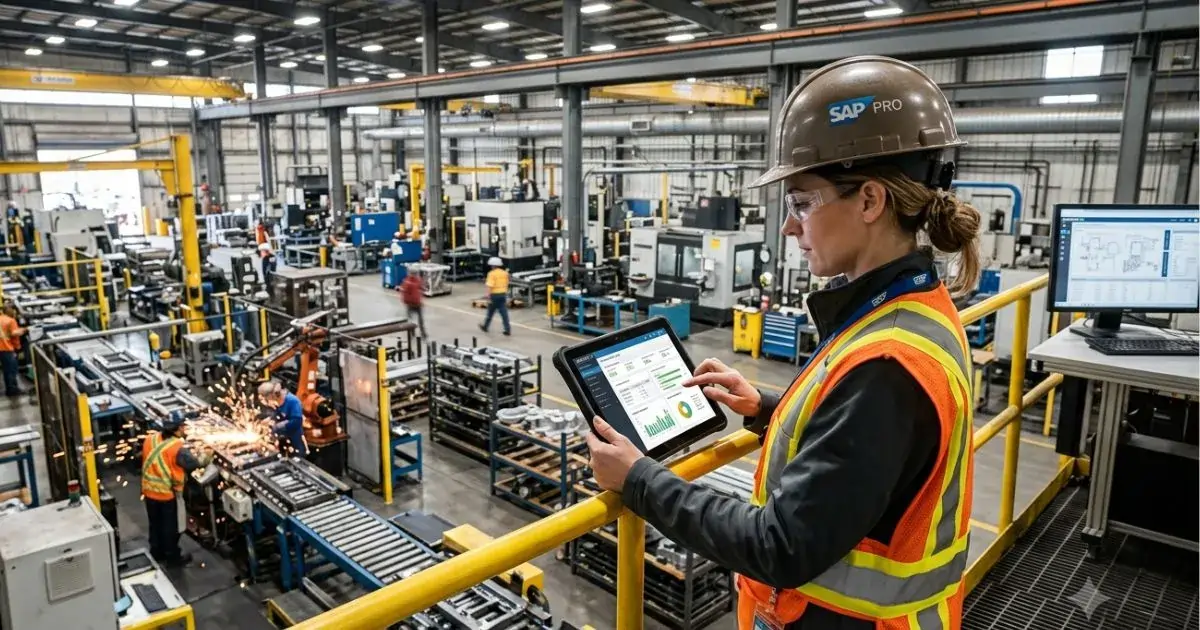
MRP software becomes important when a manufacturing business needs better control over materials, inventory, production schedules, and purchasing decisions. At a basic level, it helps answer practical questions: what materials are needed, how many are required, and when they must be available to keep production moving.
Manufacturing ERP software has a wider role. It can connect production planning with sales, warehouse, logistics, purchasing, finance, reporting, and management. Instead of focusing only on material requirements, ERP helps the business manage connected operations across departments.
The challenge is that many manufacturers are not always sure which system they need. Some businesses need a focused planning tool. Others need a broader operational platform that connects sales, production, warehouse, and delivery. This is why understanding ERP vs MRP for manufacturers is important before investing in new software.
For growing manufacturers, the decision is not only about features. It is about how work moves across the company, where information gets delayed, and whether the current system supports real operational control.
MRP stands for material requirements planning. It is mainly used to plan materials, production needs, purchase timing, inventory levels, and manufacturing schedules. In many companies, MRP is closely tied to the bill of materials, production demand, stock availability, lead times, and purchasing requirements.
A clear definition of material requirements planning can help teams understand why MRP is especially useful for production planning and inventory control. It is designed to help manufacturers reduce shortages, avoid excess stock, and keep materials aligned with production demand.
ERP stands for enterprise resource planning. ERP software is broader because it connects multiple business functions into one structure. A manufacturing ERP software platform may include production, warehouse, purchasing, sales, customer data, finance, reporting, and operational management.
IBM describes enterprise resource planning as a system that manages and streamlines organizational functions, processes, and workflows through automation and integration. For manufacturers, this broader structure can be useful when production planning is only one part of a larger operational challenge.
MRP software is useful when the main problem is planning what materials are needed for production. It helps manufacturers work from demand, orders, forecasts, bills of materials, inventory records, and supplier lead times. The goal is to make sure the right materials are available at the right time without carrying unnecessary stock.
This can be valuable for businesses that struggle with stockouts, overstocking, delayed purchasing, or unclear production requirements. If teams often ask whether materials are available, whether a purchase order should be placed, or whether a production plan can be supported, MRP can bring more structure to those decisions.
MRP software is usually strongest when the business needs better material planning, inventory visibility, and production scheduling. It may not be enough, however, when the business also needs to connect sales orders, quotations, warehouse movements, logistics, customer communication, and management reporting.
Manufacturing ERP software goes beyond material planning. It connects production with the rest of the business. This matters because production is rarely isolated. A customer request may become a quotation, then an order, then a production plan, then a warehouse movement, then a shipment, and finally a report or invoice.
When these steps are handled in separate tools, teams may need to copy data, send updates manually, and check several systems before making decisions. A broader ERP structure can reduce these gaps by giving departments a shared view of orders, inventory, production status, documents, and responsibilities.
For example, Accleverate Pulse is designed to help businesses manage sales, production, warehouse, logistics, and operations in one modular system. This kind of approach is useful when the issue is not only material planning, but also coordination across departments.
MRP may be enough when the business has a focused production planning problem and does not yet need a full operational system. For example, a manufacturer may already have separate tools for accounting, sales, or warehouse management, but still needs stronger control over materials and production schedules.
In this case, a focused MRP software solution can help improve purchasing decisions, reduce material shortages, and support more reliable production planning. It can also be easier to introduce than a larger ERP project, especially if the business has limited complexity or a smaller team.
MRP can be a practical fit when the main questions are: What do we need to produce? Which materials are required? What is already available? What needs to be purchased? When should production start?
ERP becomes the better choice when the problem is no longer limited to materials. If sales, production, warehouse, logistics, and management all need better coordination, a wider system may be necessary.
A business may start looking at manufacturing ERP software when teams rely on spreadsheets, repeated exports, manual approvals, duplicated data, or disconnected departmental tools. In these situations, the real issue is not just planning materials. The issue is that information does not move clearly across the company.
If your team is already using spreadsheets to connect sales, warehouse, production, and reporting, it may also be useful to review the signs that your business has outgrown spreadsheets and needs stronger manufacturing workflow software.
ERP is also useful when management needs clearer reporting. If leaders cannot easily see order status, production progress, inventory availability, delivery delays, or operational performance, a connected ERP structure can provide better visibility.
This is also part of a wider digital transformation challenge, where sales, production, and operations need to work from the same information instead of disconnected files.
The best way to compare ERP vs MRP for manufacturers is to start with the process, not the software category. A company should map how work moves from customer request to production and delivery. Then it can identify whether the biggest gaps are in material planning, cross-department coordination, reporting, or system integration.
If most issues happen inside production planning, MRP may be the right starting point. If issues appear across sales, production, warehouse, purchasing, logistics, and management, ERP may provide stronger long-term value.
It is also important to consider growth. A business that only needs MRP today may later need broader ERP capabilities as product lines, locations, users, approvals, and customer requirements become more complex. Choosing a flexible system can help avoid another replacement later.
A manufacturer may need MRP software if production planning is becoming difficult to manage with spreadsheets or manual checks. Common signs include material shortages, too much unused stock, unclear purchase timing, frequent production rescheduling, and limited visibility into material availability.
MRP can also help when teams struggle to connect demand with purchasing decisions. If production schedules change but material orders are not updated quickly enough, delays can appear across the workflow. A structured MRP process helps keep planning more organized.
However, if these material planning issues are connected to wider operational problems, such as disconnected sales orders, warehouse movements, or logistics updates, the business may need to look beyond MRP alone.
A business may need manufacturing ERP software when disconnected systems create repeated work across departments. Sales may manage customer requests in one tool, production may plan in another, warehouse may track stock separately, and management may depend on manual reports.
This creates delays and uncertainty. Teams may not know whether an order is approved, whether materials are available, whether production has started, or whether a shipment is ready. Over time, these gaps can affect customer communication, delivery performance, and internal efficiency.
A broader ERP structure can help connect these areas so information moves more clearly. Instead of each department working from its own version of the truth, the business can create one operational flow from sales to delivery.
Not every manufacturer needs a large, rigid ERP implementation. Some businesses need a modular approach that starts with the most important operational gaps and expands over time. This can be especially useful for companies that want stronger structure without forcing every department into a generic system all at once.
A modular enterprise platform can support specific areas such as CRM, configurators, production scheduling, warehouse management, logistics, document management, AI, and automation. The business can focus first on the workflows that create the most friction, then add more capabilities as needs become clearer.
This is where Accleverate Pulse can be positioned as a practical option for connected operations. It is built around sales, production, warehouse, logistics, and operations, which makes it relevant for manufacturers that need more than isolated MRP functionality.
Some manufacturers have processes that standard tools cannot support clearly. They may have unique product rules, complex quotation logic, customer-specific workflows, legacy systems, or integrations that do not fit well into a ready-made platform.
In these cases, custom software solutions may be the better path. Custom development can help create a system around the company’s actual operational logic instead of forcing the business to adapt to software that does not fully match the process.
If standard ERP or MRP tools cannot match the workflow clearly, it may be worth comparing custom software vs off-the-shelf software before choosing a long-term system.
This does not mean every system needs to be built from scratch. A smart approach may combine a modular platform, integrations, workflow automation, and custom modules where they are needed most.
ERP and MRP decisions are also connected to automation. Even with better software, businesses may still have repetitive approvals, reminders, document preparation, internal notifications, or follow-up tasks.
When repetitive tasks slow teams down, Accleverate Flow AI can help identify bottlenecks and automate workflows around the existing process. For a broader view of where automation fits, this article on AI workflow automation explains how businesses can reduce repetitive tasks without disrupting daily operations.
For manufacturers, automation is most useful when it supports real operations. It should reduce repeated checks, improve accuracy, and help teams respond faster when something changes.
Start by asking what problem the business is trying to solve. If the main issue is material planning, production scheduling, and inventory requirements, MRP software may be enough. If the issue is broader coordination across departments, manufacturing ERP software may be the stronger fit.
Next, consider how the business will grow. A system that works today should not become a limitation as the company adds more products, users, locations, approvals, or reporting needs. Flexibility matters because manufacturing processes often become more complex over time.
Finally, look at adoption. The best system is not always the one with the most features. It is the one that helps teams work more clearly, reduces manual effort, and supports the daily process in a way people can actually use.
MRP focuses mainly on material requirements, inventory planning, purchasing needs, and production schedules. ERP is broader and can connect production with sales, warehouse, logistics, finance, reporting, and other business functions.
MRP software helps manufacturers plan materials, manage inventory needs, support production scheduling, and decide when purchasing should happen. It is useful when the main challenge is keeping materials aligned with production demand.
A company may need manufacturing ERP software when production planning is connected to wider operational issues, such as disconnected sales orders, warehouse updates, logistics coordination, approvals, reporting, or duplicated data across departments.
In many systems, MRP can be part of a broader ERP platform. ERP may include MRP functionality along with other modules for sales, purc
Neither option is always better. MRP is better for focused material and production planning needs. ERP is better when the business needs connected workflows across departments and stronger operational visibility.
Yes. Some manufacturers begin with MRP software to improve material planning, then move toward ERP as their operations become more complex. A modular or flexible approach can make this transition easier.
Choosing between ERP and MRP is not only a software decision. It is a decision about how your manufacturing business manages materials, production, data, and coordination across departments.
MRP software can be the right choice when the main priority is material planning and production scheduling. Manufacturing ERP software becomes more valuable when the business needs to connect sales, production, warehouse, logistics, and management in one clearer structure.
If your business is comparing ERP vs MRP for manufacturers, the right next step is to map the workflow first. Look at where delays happen, where data is repeated, and which teams need better visibility. From there, it becomes easier to understand whether your business needs MRP software, a broader ERP structure, or a more tailored digital system.
Cleverativity helps manufacturing and technical businesses design software around real workflows, not generic processes. With Accleverate Pulse, your business can connect sales, production, warehouse, logistics, and operations in one modular enterprise platform built to improve visibility, reduce manual coordination, and support better daily decisions.
If your current tools no longer reflect how your manufacturing process really works, explore Accleverate Pulse or contact Cleverativity to discuss the right software path for your operations. For workflows that require unique logic, integrations, or modernization beyond standard tools, Custom Software Solutions can also help build a system around your specific business needs.
