
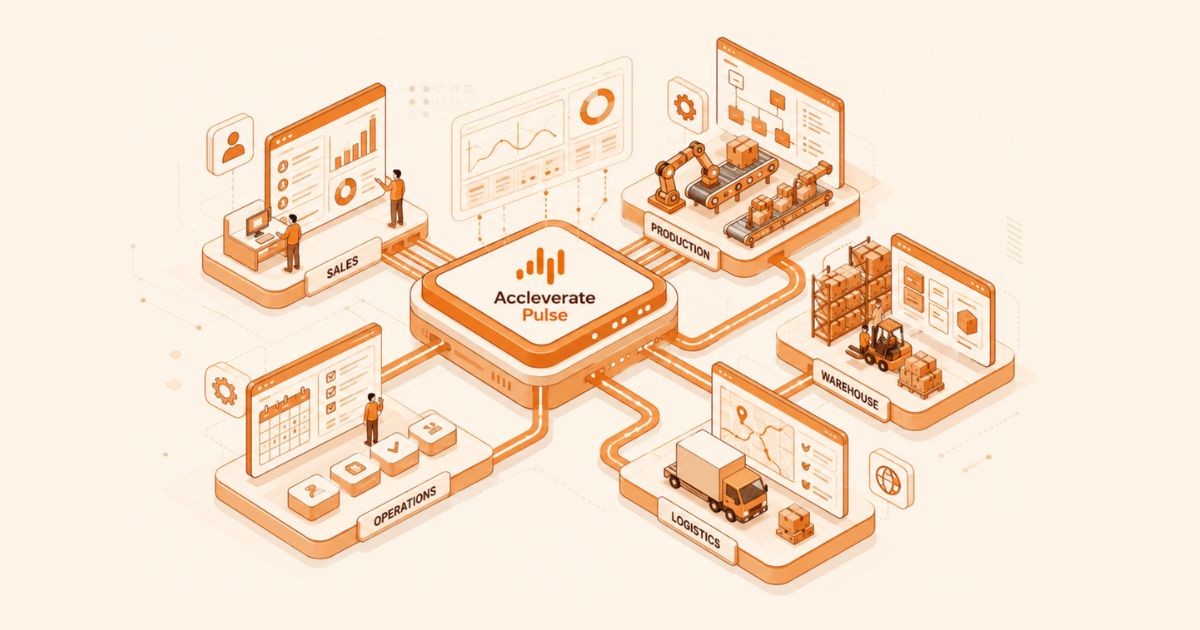
Digital transformation is not only about replacing old tools with new software. For many businesses, especially manufacturers and technical companies, it is about connecting the departments that keep daily operations moving. Sales, production, warehouse, logistics, and management often work with different systems, separate files, and fragmented information. When these areas are disconnected, teams may spend more time checking data than moving work forward.
A connected digital structure helps information move from one department to another with fewer delays, fewer manual updates, and better visibility. Instead of treating each department as a separate area, digital transformation creates a clearer flow between customer requests, quotations, orders, production planning, delivery, and reporting.
For growing businesses, this connection is important because operational complexity increases over time. More customers, more products, more approvals, and more data can make manual coordination harder to control. The right enterprise software solutions can help businesses manage that complexity with systems that support real workflows instead of forcing teams to rely on disconnected tools.
Before a business can improve its operations, it needs to understand how work actually moves. A sales request may begin with a customer inquiry, then pass through quotation, approval, production planning, warehouse preparation, shipping, and invoicing. If each step is handled in a separate tool, it becomes difficult to see the full picture.
Process visibility helps teams understand where information is created, where it changes, who needs to approve it, and where delays happen. Without this visibility, businesses may only notice problems after they affect delivery times, customer communication, or internal productivity.
Digital transformation supports visibility by bringing important operational information into a more connected structure. This does not always mean replacing every existing system at once. In many cases, it means improving how data flows between departments and giving teams a clearer way to access the information they need.
Sales and production are closely linked, but in many companies they still work from different views of the same business. Sales teams need to know what can be offered, when it can be delivered, and how customer requirements affect pricing or production. Production teams need accurate order details, technical specifications, deadlines, and approved changes.
When these teams are not connected, problems can appear quickly. Sales may promise timelines that production cannot support. Production may receive incomplete information. Customer changes may be shared through emails or spreadsheets instead of a structured process. These gaps can create delays, errors, and frustration for both teams.
Digital transformation helps connect sales and production by creating a shared flow of information. Quotations, order details, product configurations, customer requirements, and delivery expectations can move more clearly from the commercial side of the business to the operational side. This makes it easier for teams to plan work, reduce misunderstandings, and respond faster when something changes.
For technical and industrial businesses, enterprise technology for manufacturers should support the connection between commercial decisions and production realities, not treat them as separate processes.
Operations depend on accurate data. A small error in a product code, quantity, delivery date, material requirement, or customer specification can affect multiple departments. If data is copied manually from one file to another, every transfer creates a chance for mistakes.
A connected digital system reduces the need for repeated manual entry. Information can be entered once, validated, updated, and reused across different steps of the workflow. This helps teams avoid duplicated work and makes the business less dependent on individual memory or informal communication.
Better data flow also improves decision-making. Managers can see the status of orders, production progress, warehouse availability, delays, and performance indicators without waiting for manual reports. This gives the business a more reliable view of what is happening and where attention is needed.
Many operational delays come from repeated manual checks. Teams may need to confirm whether an order was approved, whether production has started, whether materials are available, whether documents are updated, or whether a shipment is ready. These checks may seem small, but they can consume a large amount of time when repeated every day.
Digital transformation can reduce this work by creating clearer workflows, automated notifications, structured approvals, and shared dashboards. Instead of asking for status updates through email or chat, teams can see the latest information inside the system.
For repetitive tasks and internal coordination, workflow automation can also help teams reduce manual follow-ups, improve response time, and keep important actions moving through the right process.
This does not remove the need for human judgment. It simply helps people spend less time searching for information and more time making decisions. For businesses that manage complex operations, this can improve both speed and accuracy.
Production planning becomes more difficult when teams do not have reliable information about sales demand, material availability, workload, and delivery commitments. If planning is based on outdated spreadsheets or incomplete updates, the business may struggle to balance customer expectations with operational capacity.
Digital transformation helps production teams plan with better information. Orders, forecasts, stock levels, deadlines, and production requirements can be connected in one operational view. This allows teams to identify bottlenecks earlier, adjust priorities, and coordinate resources more effectively.
For manufacturers, enterprise software solutions can also support more structured planning around materials, production schedules, warehouse movements, and logistics. This is where the value of connected operations becomes practical: each department can work with information that is more accurate, current, and aligned with the rest of the business.
Disconnected systems often create disconnected teams. When departments work with different versions of information, collaboration becomes harder. Sales may think one thing is confirmed, production may be waiting for another detail, and management may only see the issue after it has already caused a delay.
A connected digital environment gives departments a shared reference point. It helps teams understand what has been approved, what is still pending, who is responsible for the next step, and how one department’s work affects another.
This improves communication because discussions can be based on the same data. Instead of debating which file is correct or searching through emails, teams can focus on solving the problem. Over time, this creates a more organized and accountable way of working.
Digital transformation requires more than adding isolated tools. A company may already use CRM software, spreadsheets, accounting platforms, warehouse tools, or project management systems. But if these tools do not connect clearly, the business may still experience the same operational gaps.
Enterprise software solutions help by creating a stronger structure around workflows, data, approvals, reporting, and integrations. The goal is not simply to digitize individual tasks. The goal is to support the full process from the first customer interaction to delivery and ongoing management.
For example, a modular platform such as Accleverate Pulse can support connected workflows across sales, production, warehouse, logistics, and operations. This type of system helps businesses improve visibility, reduce duplication, and create a more reliable operational foundation.
One common mistake is starting digital transformation by choosing a tool before understanding the process. The better starting point is to map how the business works today and where the biggest friction appears.
A business should ask: what information is repeated across departments? Where do delays usually happen? Which approvals are still manual? Which reports take too much time to prepare? Which systems do not communicate clearly? Which processes depend too much on individual knowledge?
The answers help determine whether the business needs better integrations, workflow automation, custom software, a modular enterprise platform, or a combination of solutions. Digital transformation should support the way the business operates and improve it step by step.
When standard tools cannot support these needs clearly, custom software can help build a system around the company’s actual workflows, data structures, approvals, and operational logic.
Digital transformation works best when it is guided by business goals, not only technical upgrades. A company may need better visibility, faster reporting, fewer manual steps, stronger collaboration, or more reliable production planning. The technology should support those goals clearly.
This is why the process should begin with workflow analysis. Before choosing a platform, businesses should understand where information is delayed, where manual work creates errors, and which departments need better coordination. From there, the right mix of enterprise software, automation, integrations, or custom development becomes easier to define.
For businesses managing sales, production, warehouse, logistics, and operations, this is also the point where a modular enterprise platform such as Accleverate Pulse can become useful. Instead of adding another isolated tool, the business can create a connected structure that supports daily workflows, improves visibility, and reduces repeated manual coordination.
If the main issue is repetitive internal tasks, approvals, reminders, or follow-ups, Accleverate Flow AI can support workflow automation around the existing process. If the business needs a system built around unique rules, integrations, or operational logic, Custom Software Solutions may be the better fit.
Digital transformation means using technology to improve how business processes work. For operations, this often includes better data flow, connected systems, workflow automation, shared visibility, and more structured coordination between departments.
Digital transformation connects sales and production by helping customer requests, quotations, order details, approvals, and production requirements move through a clearer system. This reduces manual communication, improves accuracy, and helps teams work from the same information.
Enterprise software solutions are important because they help businesses manage complex workflows across departments. They can connect data, approvals, reporting, production planning, warehouse activities, and logistics in a more organized structure.
A business should consider digital transformation when teams rely heavily on spreadsheets, repeated manual work, disconnected systems, slow reporting, unclear approvals, or frequent communication gaps between departments.
No. Digital transformation can support businesses of different sizes. The right approach depends on the company’s stage, complexity, budget, and goals. Smaller businesses may begin with simpler tools, while growing companies may need more structured enterprise technology.
Digital transformation helps businesses move beyond disconnected tools and manual coordination. When sales, production, and operations are connected, teams can work with clearer data, better visibility, and stronger collaboration.
For manufacturers, technical companies, and growing B2B organizations, this connection can improve how work moves from customer request to delivery. It can reduce errors, support better planning, and give management a clearer view of daily operations.
Cleverativity helps businesses design digital systems around real workflows, from enterprise software solutions and workflow automation to custom software and connected operational tools. Explore Accleverate Pulse to see how a modular enterprise platform can support sales, production, warehouse, logistics, and operations in one connected structure.
